
 Posts
Posts


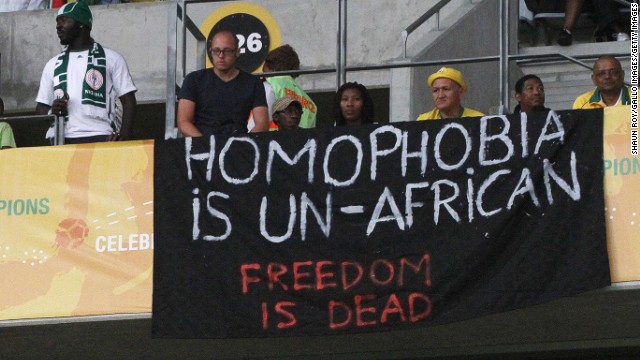
A protest takes place against Nigeria's anti-gay marriage law at Cape Town Stadium on January 19, 2014 in South Africa.
Editor's note: Olumide Femi Makanjuola is Executive Director at The Initiative for Equal Rights (TIER), which ensure human rights protection and promotion regardless of sexual orientation and gender identity.
Lagos, Nigeria (CNN) -- Nigeria is second only to South Africa
as the country with the highest number of HIV/AIDS sufferers; one would
have thought a better gift for the New Year from the government to its
people would be to urge the national legislature to pass the anti
HIV-discrimination bill that has been with them for a while.
But alas, what the people
received was a bill that further exposes them to violence and
discrimination. While the signing of the bill has generated much
reaction on both sides, most of its supporters have based their
arguments on religion and African values, forgetting that what binds the
nation together is not the divergence of religions but the respect for
humanity that is enshrined in the 1999 constitution.
Olumide Femi Makanjuola
What the same-sex
marriage (prohibition) bill in fact does is negate the principle of
fundamental human rights of association, expression and dignity. When a
law does this, it runs the risk of breeding anarchy, an experience that
people who are or are merely perceived to be gay know all too much about
in the form of blackmail, extortion and fear of arrest.
The law also acts against the principle of public health. With rates of HIV infection and AIDS running at 3.7% for the general population, and 17.2% among gay men, criminalizing organizations providing intervention for this population puts all Nigerians in jeopardy.
Another thing to note is
about the public perception of the law: while many perceive there's
casual acceptance by many Nigerians of the bill, in fact many of those
who have commented on the bill have not even read it.
Nigeria's anti-gay law called 'draconian'
Aside from the fact that
sections of this law are in direct violation of our fundamental human
rights -- freedom of expression and assembly, freedom to have a private
and family life -- and set back the provision of healthcare services,
they effectively signify that it is open season to attack the lesbian,
gay, bisexual and transgender (LGBT) community and mainstream society in
general.
Already 10 people have been arrested
for their perceived sexual orientation by law enforcement agencies
across Nigeria, a human rights group said. The witch hunt to arrest many
more by forcing names out of those arrested is also gathering momentum.
The disturbing factor here is on what basis these individuals were
arrested; we believe most have been detained due to anonymous tips that
are inaccurate in most cases.
Many more of these violations of human rights will take place if this law is not repealed; blackmail and extortion
will become commonplace against LGBT people and the Nigerians at large
and little will be done to ensure that organizations providing
healthcare service for this population are able to carry out their work
in responding to the HIV/AIDs epidemic in the country.
We therefore implore the
Nigerian President and his good government to repeal this law, which, we
fear, could blow into an unbearable catastrophe for Nigeria and its
citizens.


No comments:
Post a Comment